

Ask most Malaysians to name a great local rom-com and you’ll get the same couple of answers, both aging: Gol & Gincu, Ice Kacang Puppy Love. If you go back a little further, some Gen-Xers might say Puteri Impian. The Malaysian rom-com has never been absent, not exactly, but it’s a rare entry into our cinematic canon, surfacing maybe once a decade before going quiet again.
In the meantime our screens fill with action and horror: profitable, plentiful, and leaving a particular kind of gap. Which is why Mojoku Hilang, and La Luna before it, are worth stopping on. Two rom-coms, arriving close together, that don’t just revive the form but quietly reshape it.

The reshaping is easiest to see in what these films do with the couple. In Mojoku Hilang, Adi is a corporate man sent undercover to a Perlis kampung to claw back Mojo, a viral cow that the villagers have kidnapped to stall his company’s takeover of their farms. The woman he falls for, Ayu, isn’t a love interest parked beside the plot; she’s the farmer’s daughter leading the resistance, the loudest voice against everything he was sent to do. The romance doesn’t run alongside the community story. It is the community story, compressed into two people on opposite sides of it. That’s the trick the film pulls: you can’t root for the couple without rooting for the kampung, because they’re the same wish.
La Luna works the same idea from the opposite direction. Its inciting incident is a lingerie store opening in Kampung Bras Basah, a village held in place by a stubborn religious leader who won’t permit change, or fun, even as the kampung plainly wants both. The store is a clever device: it forces the film’s real subject, tradition against change, into the open through the whole ensemble rather than a single couple. The romance is seeded early, but the film keeps reeling it back whenever the community’s story needs the floor. It plays less like a romance with a village and more like a village film that happens to contain a romance.
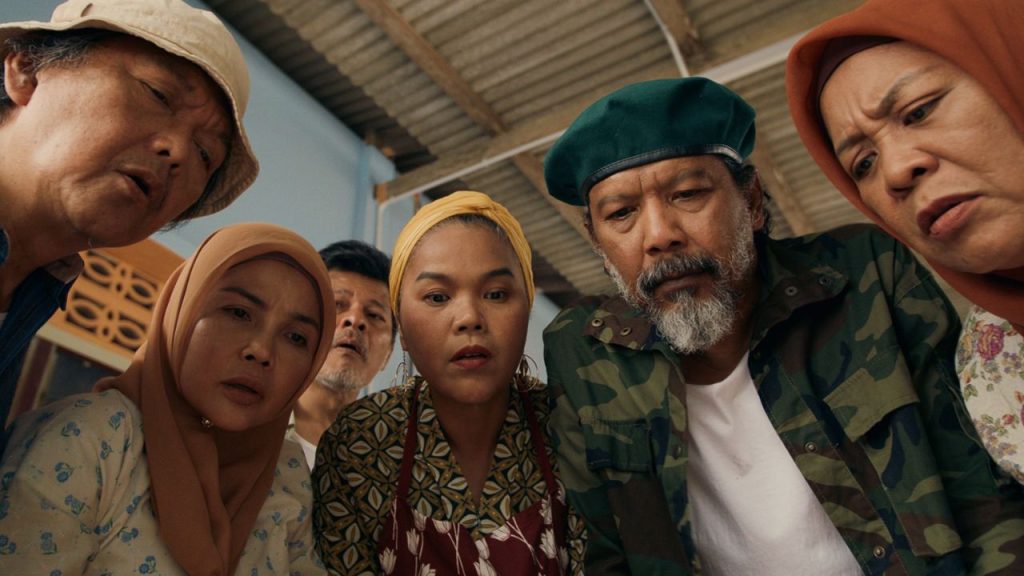
That inversion is the genre’s actual innovation, and it isn’t by accident. The Western rom-com is built around a couple, supporting friends and family are woven in, but the frame stays on the two leads and their particular problem. These films widen the frame. The couple is one thread in a larger fabric of neighbours, elders, outsiders, and the place itself, and the romance reads as organic precisely because it’s never asked to carry the picture alone. It’s a structural choice: put the community in the foreground and the love story stops feeling like formula and starts feeling like real life, where individual journeys are always a small part of something collective.
None of this makes them less rom-coms. It makes them a different species of one: unhurried, ensemble-driven, and unmistakably local without straining to be. They aren’t pitched at a Western market and they don’t feel derivative, because the thing that distinguishes them isn’t a gimmick bolted onto an imported formula. It’s a way of telling stories that were already ours. If this is what Malaysian filmmakers can do by taking a tired genre and running it through our own idea of community, then the drought between great rom-coms might finally be worth the wait. Here’s hoping it won’t be a drought much longer.