
Ddakji. Red light, green light. Dalgona. Hide and seek. Mingle. Squid game. What do all these have in common? First, they’re popular children’s games, mostly unique to South Korea. Second, they were featured on Squid Game and are enjoying a boom in global popularity. But what many people might find surprising is that these games, both in real life and on Squid Game, reflect the ruthless forces of neoliberalism and teach neoliberal market ideologies.
South Korea is one of the world’s great economies and a poster child for hyper-capitalist neoliberalism. But in its early decades, modern South Korea’s economic development was guided by the state, which fostered ties between the government, banks, and corporations. Thanks to the disastrous 1997 financial crisis, the nation became more openly neoliberal, including embracing neoliberal practices like free market liberalisation and deregulation. Even the social and private spheres could not escape the domination of neoliberal pressures.
For the average South Korean citizen, this shift meant learning to play the games of the marketplace. Neoliberalism crept into all levels of daily life. Work, shopping, fitness, dating, and family relationships transformed into arenas where everyone must compete, not just to succeed, but to survive. People internalise neoliberal values like hard work, competitiveness, self-reliance, strategy, and enterprise. These values might seem natural and even noble, but in hyper-capitalist societies, they can create cut-throat, winner-takes-all behaviours.
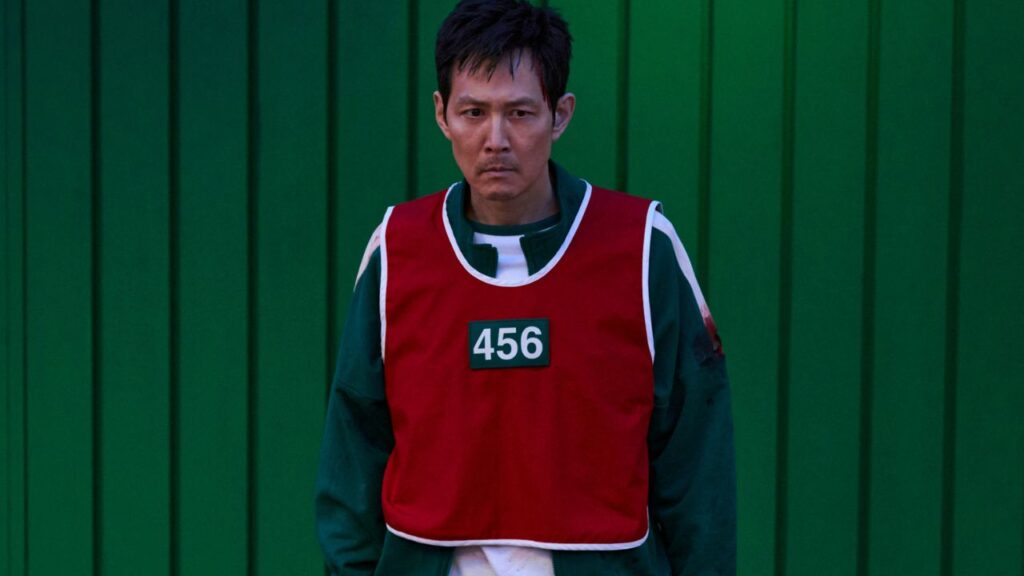
Squid Game shows how seemingly benign children’s games are embedded with neoliberal ideologies and how they are further enforced in the participants’ behaviours. The games Gi-hun and the other 455 players must play are familiar to them, but on the island, the games’ true neoliberal nature becomes terrifyingly deadly. The very structure of these games, the reward system, rules, and penalties, compels players to actively embrace neoliberal mentalities like self-reliance, craft, and backstabbing.
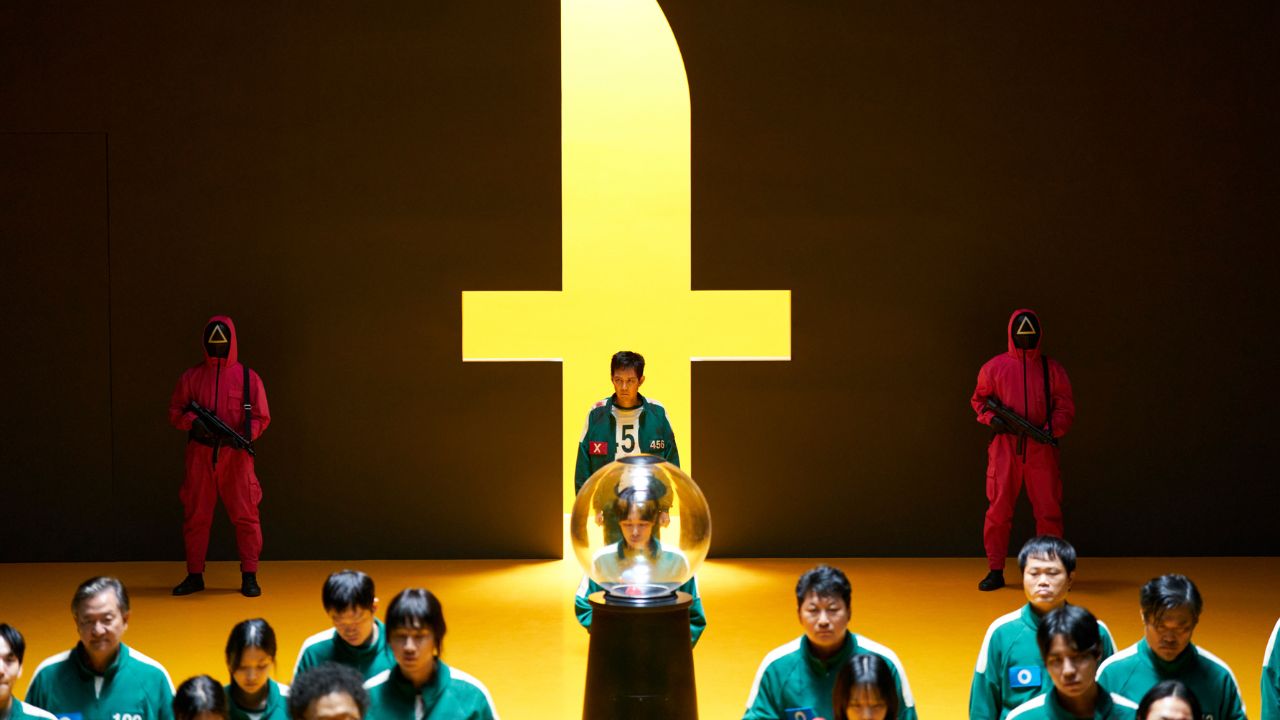
One of my favourite games on Squid Game is Mingle. Players are spun on a giant carousel, then forced to quickly form groups in pre-determined numbers. Those who fail are gunned down. The game’s design intentionally inflicts the cruelties of neoliberalism. First it encourages players to cooperate, like when Gi-hun and Hyun-ju’s teams combine forces. But soon they are torn apart when team numbers are whittled. In Mingle, neoliberalism corrodes solidarity; players are rapidly forced to hyper-fixate on individualism in order to win.

Unsurprisingly, the most hated characters each season are the entrepreneurs. In Season 1, businessman Sang-woo betrayed Ali. In Season 2, crypto trader Myung-gi is the consummate neoliberal player. During “Hide and Seek,” he goes on a killing spree. What makes Myung-gi despicable is that he kills other players, not to win or survive, but to maximise his economic earnings. Myung-gi has so internalised the logic of neoliberalism that any morality or compassion is short-circuited in favour of financial hyper-competitiveness.
Even between games, neoliberalism influences the players’ behaviours. After each game, players can vote to take the prize money and leave, or stay to play. Squid Game critically exposes how democratic practices like voting are largely embedded with neoliberalism, which coerces people’s choices. Against all sanity, most players keep voting to play. They are so indoctrinated by the neoliberal desire for financial freedom from debt that their natural self-preservation and empathy are overridden.
Recent political events have proven how robust South Korea’s democracy is. Notably, on Squid Game, players are given red and blue tags after voting, which are the colours on the South Korean flag. Although the squids ensure that the voting is fair and unrigged, the voting system, based on the illusion of meritocracy, is deeply flawed. Gi-hun and the others who vote to leave are constantly held captive by the majority vote. When the will of the people is neoliberal, everyone is hostage to the game.
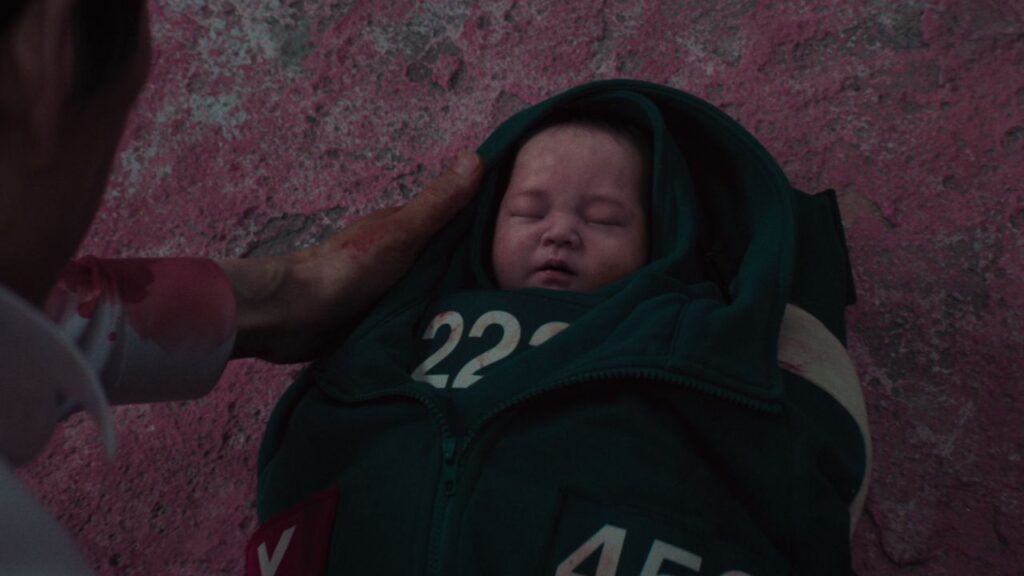
In social species, young ones play. Yet games are never innocent or neutral. Playing games teaches what a culture values most: in neoliberal societies, that means respecting the rules and striving to win. In Squid Game, neoliberalism becomes life or death in children’s games. I’m not surprised the winner was the baby. Although the baby is set for life financially, it’s a grim reminder that the baby’s entire existence is marked by neoliberal forces.
Ultimately, humans are… born to play. The show’s ending reveals that the game has been exported to America. And the fact that Squid Game-inspired shows like Squid Game: The Challenge exist in the real world proves that viewers have learned nothing. In fact, like the players who kept voting to stay, viewers are clearly hungry to keep playing.